Veraison: from berry growth to berry ripening.

Veraison: from berry growth to berry ripening.
Showing posts with label It has nothing to do with the grape. Show all posts

Tuesday, December 27, 2011

The pleasures of dining alone


I have a crush on the juice of vitis vinifera because it delivers much more to our lives than aroma, flavor and 90+ ratings. It brings the joyful sound of friends connecting at the dinner table. What is more nourishing and life affirming than sampling the appetizers, savoring a newly discovered wine, exchanging a few jokes and pleasantly easing our way through a multi-hour, relaxing dinner with our closest friends? And with the clinking of glasses and the toasts of health and good wishes, wine also provides an underappreciated cohesion to that fundamental, spirit-lifting gathering.

Furthermore, if conditions are appropriate and its quality warrants it, the dinner wine can be discussed and analyzed, praised or criticized, either of which adds yet another dimension to the occasion. Wine, therefore, can transform the basic function of eating into a special dining occasion. All things considered, it seems that wine, therefore, is man’s quintessential communal beverage, and with that thought in mind, it is best enjoyed with those whose company you value.

Ah . . . but I must confess that there are times when I’m not with others—when I’m “doing my Lucullus thing” and dining alone. Lunchtime at home is the typical venue, and I’ve either prepared something from scratch, or have enhanced last night’s remnants with a few savory accompaniments. Inevitably my culinary effort becomes wine-worthy, so I pour myself a glass from dinner’s half-empty bottle. Alone and undistracted by conversations with others, I have the unhurried and heedful moments to quietly assess and fully appreciate the qualities of the wine in front of me. Its clarity, depth and brightness; the clean and enticing aroma of citrus and herbs; its crisp, palate cleansing acidity. A wine of purity and . . . .

Lucullus? Lucullus, you’re wondering?

Lucius Licinius Lucullus was a Roman Consul and General, circa Julius Caesar’s time. Even though he was a particularly effective military commander, Lucullus is remembered more for his extravagant lifestyle after he retired to private life. His wealth—variously flaunted—included several luxuriously designed and appointed villas with fabulous, ocean-fed fish ponds, as well as lavish Persian-inspired gardens. (Ideas picked up during his military campaigns.) In addition, and on a more altruistic scale, he owned and housed an exceptional library collection in Rome which contained that era’s finest manuscripts and books; they were available for studying by any and all—but particularly philosophers and literary scholars.

However, Lucullus is forever associated with his over the top, lavish-in-every-respect, gastronomic, entertainment events (think “Lucullan feasts”) that he hosted for Greek Philosophers, visiting foreign dignitaries and influential Roman politicians. Moreover, even though he enjoyed feasting on the best of everything with his dinner guests, he also apparently maintained that same hedonistic lifestyle while dining alone.

According to Plutarch, one evening while dining at home—alone and without guests—he apparently felt that something was amiss in the kitchen; the evening’s dinner was ordinary at best. And so, eager to apprise him of the shortfall, Lucullus summoned his nervous Chef and immediately chided him for the lack of imagination and magnificence in his meal. Wishing to explain why, the chef responded that he thought it was unnecessary to produce the usual level of excellence inasmuch as Lucullus was not hosting anyone special that evening. Big mistake. Lucullus, appalled at the insinuation, barked, “Are you not aware that tonight Lucullus is host to Lucullus?” Adding, furthermore, that this is precisely when extraordinary efforts are required. No word from Plutarch on where the Chef’s next job was.

Lastly, while dining alone—with our without the bonus of a live-in Chef—can provide a few, beneficial moments of introspective solitude, there is no question that dining with family and friends is the better pathway to an enriched and healthy life. With that in mind, and with 2012 just a few days away, I hope your New Year will be happy, healthy and prosperous.  Further, I hope that you will pour some love and affection, and uncork one of those special bottles that you've secretly stashed for special occasions.

Monday, October 10, 2011

What Is Happening To France?

Wine’s central and embedded role in France’s long and storied cultural history is without dispute. It has been a vital part of their economic survival as well as their lifestyle for generations.

The food and drink of a nation is a window into its soul.  Quite revealingly, the French considered wine nothing more than a healthy food accompaniment.  It was always consumed in moderation, and was never really thought to be, in the strict sense of the word, an “alcoholic beverage.” The legal drinking age for wine (and beer) at eighteen (recently upped from sixteen) has reflected that attitude. French youth, via strict parental supervision and oversight at family dinners, consumed wine in a mature and responsible manner.

However, those pleasant, nostalgic days of old seem to be ending. A strong anti-alcohol movement—rooted in a 1991 law that strictly regulates alcohol and tobacco advertising—has unfortunately taken its toll on French wine attitudes and consumption. “Evin’s Law,” as it is known, strictly forbids anything other than factual information in publicity or advertising releases.

Wine tasting reviews, that hint at attractive and enjoyable qualities, that are commonplace in American newspapers and magazines, are now strictly verboten in France. And international wine and spirits companies have their own set of marketing roadblocks as their Internet sites must now adhere to those same restrictive guidelines. As such, their web sites are often inaccessible to French Internet surfers.

In addition to, and what partially validates the above anti-alcohol movement, is the dramatic shift in the alcohol attitude and behavior of French youth. “Le binge drinking,” (the officially term, intoxication alcoolique aigue, never really cut it) formerly the exclusive partying pastime of British and American college-age youths, seems firmly entrenched in the alcohol intake patterns of their French counterparts. Mind altering seems to be the goal as they now drink with reckless abandon—indoors at parties, but more often outdoors in the streets. Getting smashed is what it’s all about, and beer and hard alcohol are the accommodating beverages.

Within the last year or so, numerous raucous binges have occurred in France, often with serious injuries to the participants and significant damages to nearby private property. Many of these events have been organized and promoted via various Internet social media like Facebook and Twitter. As such, crowd sizes soared to the thousands—some articles claim crowds as high as 6,000. (Dionysian, cult-like events in a 21st century setting!)

The last annoying bit of cork debris in the wine glass is a 2008 survey from Credoc, a French research center, which claims that just over half the French feel that wine is not a safe or healthy food product. (Charcuterie—that Gallic culinary art which includes such fabulous creations like pâtés, terrines, galantines and ballotines—is viewed with even more suspicion!)

Finally, and quite dispiritingly, many of the French no longer view wine as their forbears did, for there is also an emerging mind-set that wine is nothing more than a pretentious beverage. Is it any wonder then that wine consumption, per capita, has fallen gradually to a point where it is now fifty percent less than it was in 1980? What is happening to France?


Saturday, September 24, 2011

Finding Your Wine IQ


(1) You can tell if a wine is “dry”, (a) If nothing comes out when you pour, (b) If no “legs“ appear after swirling the glass, (c) If it doesn’t taste sweet, or (d) If you’re still thirsty after you drink it.

COMMENT: If you don’t know it’s (c) , the rest of the quiz may be somewhat of a challenge for you.  

(2) Wine drinkers love California Chardonnay because (a) It tastes like butter, (b) It tastes like vanilla, (c) It tastes like tropical fruit, or (d) It tastes like . . . well . . . all of the above.

COMMENT: Crazy as it seems, it’s “all of the above.” It’s a wildly popular style, but there are indications that many wineries are starting to lighten up on these aspects.

(3) "The French Paradox" (a) Is an HBO sequel to the famous Gene Hackman movie The French Connection, (b) Clarifies which wine is an appropriate pairing with snails (c) Caused the sales of red wine in America and elsewhere to soar, or (d) Explains why a life filled with fromage, pâtés, and foie gras doesn't decimate the French population.

COMMENT: A segment on TV’s “60 Minutes” many years ago gave red wine a big push implying it is the underlying cause why someone in France doesn't die every five seconds.  The answer is (c) and (d).

(4) The preferred way to buy wines is (a) The prettiest bottle label, (b) If the word “Chateau” appears anywhere on the label, (c) If it costs under five bucks, or (d) Any way you damned well please.

COMMENT: Research shows that (a) is quite popular. Sales show that (c) is alive and well. On the other hand it’s pretty hard to argue with (d).  I'm a believer that the word "Chateau" has some subliminal appeal, but have no evidence to support that theory.

(5) Pinot Grigio (a) Is Pinocchio’s brother, (b) Is the Italian version of Alsace’s Pinot Gris, (c) Is an Argentine wine made from Pinot Noir and Grenache, or (d) Is a warning about Viagra’s side effects.

COMMENT: Leave it to the French and Italians to differ. Pinot Grigio are Pinot Gris are twins, even though quality-wise and stylistically they are quite different.  The Viagra thing is a crass, unsubstantiated rumor.

(6) Rioja is (a) An expletive that Flamenco dancers yell at the end of their performance, (b) A wine bag that Spanish sheepherders carry over their shoulder, (c) Spicy Spanish rotisserie chicken, or (d) One of Spain’s premier wine regions.

COMMENT: It may be served at Flamenco concerts, and sheepherders may love it with their pollo, but wine from the Rioja wine region is one of the great values in world class red wine.

(7) Pinot envy (a) Was Freud’s field of expertise, (b) Occurs outside of France, (c) Has something to do with Pinot Noir, or (d) Occasionally afflicts short men who drive sports cars.

COMMENT: There is a certain world envy of Burgundy’s style of Pinot Noir, but not sure if Freud knew about it or if short men even give a shift.  

(8) Acidity is (a) What cleans the palate between bites of food, (b) What results from a nervous stomach, (c) More common in Old World wines, or (d) To white wine what tannins are to red wine.

COMMENT: Don’t let this quiz get you nervous. The other three are correct.

(9) A wine's "Finish" is also known as, (a) The aftertaste, (b) The lingering farewell, (c) The tail of the peacock, or (d) The bottle is empty.

COMMENT: Somewhat misleading and sneaky, but only the real wine geek will know that (a) (b) and (c) all mean the same thing.

(10) “Super Tuscan” is (a) Frances Mayes’ next “tell all“ book, (b) An Italian weightlifter, (c) A very large plate of antipasti, or (d) An Italian Sangiovese-based red wine.

COMMENT: Sangiovese-based red wines are always enjoyed under the Tuscan sun.

(11) You can tell if a wine is full bodied, (a) By the shape of the bottle, (b) By the wine’s weight on your tongue, (c) By how deeply your teeth are stained, or (d) By how much your joints ache the next morning.

COMMENT: It has to do with alcohol level, but (b) is the correct answer, even though I know some people who swear by (c) and (d).

(12) Europe’s Appellation system has something to do, (a) With growing apples, (b) Guaranteeing a product’s authenticity, (c) With rating their adult movies, or (d) With the movement of heavenly bodies.

COMMENT: If the label says “Bordeaux” it’s the real thing. Authenticity is what the system is all about.

(13) Chablis and Burgundy, (a) Are mountain grown wines, (b) Come in large, screw-cap half gallon bottles, (c) Are French appellations, or (d) Were invented in Modesto, California.

COMMENT: They’re quintessential French wines, no matter what the people in Modesto say.

(14) The basic food and wine matching rules are, (a) White wine with fish, (b) Red wine with meat, (c) Pink wine with anything, or (d) We don’t need no stinking rules.

COMMENT: As in all matters of the grape, do what you want, even if it means beer.

(15) A wine’s appearance, aroma, and flavor are most significantly determined by (a) The age of the vines, (b) The age of the winemaker, (c) The use of manure, or (d) The use of whole cluster fermentation.

COMMENT: Sorry, trick question. None of the above. The “answer is “ grape variety,” because its inherent nature, will determine those vital qualities.

(16) Wine appreciation requires, (a) A pronouncing dictionary, (b) Deep pockets, (c) A temperature controlled wine cellar, or (d) Special decanters and expensive wine glasses.

COMMENT: While some wine geeks have “all of the above,” none are really required.

(17) Aging potential is something that (a) Is not for sissies, (b) Not all wines have or need, (c) Is one measure of a wine’s quality, or (d) Occurs naturally if you take your daily stroll.

COMMENT: All of the above. I know (a) and (d) have nothing to do with wine, but it’s my quiz.

(18) Anticipated maturity is when (a) One moves from cola to wine, (b) One buys a refrigerated wine vault, (c) One starts collecting Social Security, or (d) A wine is at it plateau of drinkability.

COMMENT: Irreverent types may say “all of the above,” however, the answer is (d).

(19) Sauvignon Blanc is (a) The white version of Cabernet Sauvignon, (b) The same wine as Fumé Blanc, (c) The same wine as France’s Pouilly-Fumé, or (d) The same wine as France’s Sancerre.

COMMENT: You’re a true Sauvignon Blanc fan if you know that (b), (c) , and (d) contain the same grape.

AND THE FINAL, MOST IMPORTANT QUESTION IS:

(20) If you know the appellation, (a) You know the grapes, (b) You know the wines, (c) You know more than most American wine drinkers, or (d) People think you’re a wine snob.

COMMENT: No matter what people may think of you, the first three are accurate.

                        ******************************************

ABSOLUTELY FINAL COMMENT: If you got fewer than 10 correct, you need to start uncorking more wines and stop drinking all that Bud Light.  Between 15 and 19 correct means your wine corkscrew is wearing out and will soon need replacement.  And if you scored a perfect 20, then it means your friends surely look forward to a festive dinner at your home.


Wednesday, August 24, 2011

When Big Brother Is In The Wine Business

The state of Pennsylvania is famous for a number of things. It is home to Punxsutawney Phil, the Liberty Bell, Hershey Chocolate and America’s first zoo. It is where the Declaration of Independence was signed, Betsy Ross made the first American flag and where the Philly Cheesesteak Sandwich was invented. It is also where its residents were characterized by one politician as being bitter and still clinging to their guns and religion.

However, from a more captivating, wine trivia perspective, Pennsylvania is one of nineteen or so states that have the right to control and regulate the sale of wine and other alcoholic beverages. Some states license the retail aspects and take their appropriate portion. (Clean and simple.) Others manage all distribution aspects including retailing. (Not so clean and simple.) Pennsylvania is in the latter group and retains total control via its Liquor Control Board (PLCB).

PLCB outlets are the only locations where wine can be purchased, and most are not conveniently attached to food markets. However, since retail brick and mortar business is not without significant costs and operational issues, the PLCB opted for another approach to offer one-stop-shopping to its residents. They elected to have someone design and install wine dispensing (vending) machines and station them inside supermarkets. This new program was dubbed Wine Kiosks by the PLCB. What could be simpler?

However, once the machines had to comply with the PLCB’s requirements of not selling wine to intoxicated or underage persons, they then became something more than mere dispensers of nature’s nectar.

The PLCB Kiosks, while promising convenience, immediately displayed their shortcomings. Limited selections, the inability to examine the labels for information, and the complete lack of interaction with informed sales clerks were but a few. But those somewhat irritating indignities were rather minor when compared to the Orwellian twists when, after selecting wines, the customer moved rightward, from the encased bottles, to an ATM-like station and tried to finalize the transaction.

To appreciate the particulars of PLCB’s vision, you must put yourself into the shoes of the potential customer. First, to prove you are over 21 you must swipe your driver’s license or other approved identification (ACLU where ARE you?). Next, to prove you are the person on that ID, you must stand in front of a surveillance camera which transmits your image to someone—hopefully not in India or Pakistan—in the State employ that decides if you look anything like that flattering, jailhouse photo on your DMV license that was taken several years earlier.

Third, then to prove you are not in an alcohol-altered, state of mind, (.02 is the zero tolerance level in Pennsylvania) you must lean forward and breathe into a breathalyzer-sensor that looks every bit as inviting as the mouth of a 20 pound, bottom-sucking Catfish! (No telling who or what breathed into that before you.) However, once you have navigated those spirit-lifting procedures, then you have earned permission from Big Brother to purchase your wine. Hey, what could be simpler and less degrading? Of course, just about anything, even if the machine efficiently dispensed your choices—which apparently they have had a tough time doing!

Recent news releases indicate that the Wine Kiosk program has been a colossal failure. Machine failures, downtimes during key holidays, pissed off unionized workers at State outlets, and unreceptive citizens were but a few of the reasons. However, when a well-known grocery chain removed the machines because “they were a detriment to business,” that served as an early warming that the Kiosks were destined for the scrap heap of wine history. However, the last nail in the coffin, the final Kiosk calamity, the most ignominious of all possible embarrassments, is when Walmart reversed their decision to install kiosks in 23 of their Pennsylvania stores. The Walmartians—that picturesque group of otherworldly body and style types that are ridiculed in numerous emails— must be beside themselves.


Tuesday, July 26, 2011

Reliving memorable wine experiences

I was reading an article recently about Germany’s wine regions, and it called to mind one of my experiences about the (perceived) quality of wines that are consumed while vacationing in another country. Some years ago my wife Helga and I visited her relatives in Germany, and while there we made a number of exploratory side trips to various Michelin and relatives-recommended destinations—scenic lakes and towns, ancient and picturesque castles and well-known winegrowing regions.

One of our more memorable side trips was roaming the circuitous, grapevine-laden roads of Baden-Württemberg,  a beautiful wine producing region southeast from Helga’s hometown. We gassed-up my brother-in-law’s spunky Volkswagen Beetle, filled a small tin flask with homemade Schnaps, a clear fruit-based brandy (courtesy of Helga’s uncle), and headed out to sample and savor the food and wine of that appellation.

Those were the carefree, reckless days of traveling without hotel reservations, when the dwindling twilight moments were often spent anxiously searching small, storybook forest towns for life-saving Zimmer Frei (room available) signs. But during the daylight hours, however, the first order of business was touring the vineyards, sampling the wines and drinking them again in the local, quaint, half-timbered, family owned inns that served the hearty dinner faire of schnitzels, bratens, kartofelsalats, as well as the local specialties, maultaschen and spaetzle. Life was not just good, it was Sehr Gut!

After sniffing, swirling, and spilling our way through the various red, white, and salmon-colored wines, we eventually found a wine that stood out from the rest. It was pinkish, semi-dry and lively, which is where our palates were at the time. Weissherbst—Germany’s version of a delicate Rosé—was perfect for casual midday sipping and snacking, and an ideal partner with our lunchtime or evening food. It quickly became our “go to” wine while we were there. Moreover, since Weissherbst was unavailable in the States, we decided why not bring a few bottles home and share them with friends? Indeed, why not?

We invited them for dinner, plated the food and poured our special, show-and-tell wine. After the first sip, my wife and I exchanged several panic-filled glances. It was not even close to what we remembered. It was simple and no better than common Tafelwein (table wine), which, in the clarity of hindsight, it was. Our friends, gracious as always, praised it as a “very nice” wine. We were crushed. Our memorable experience in Germany was not duplicated in the least. Why didn’t it excite us as it first did? Was our original perception flawed by too much food and drink?

The answer, I feel, lies with the notion of context—the circumstances that comprise the setting or environment. It has to do with ambience, mind-set, expectations and quite possibly, even hopes and dreams. It affects how one perceives music, food, wine or any other uniquely personal experience. In our case, we were vacationing and in a relaxed, romantic frame of mind. We were enjoying the food and wine of a lake and forest-filled, castle-dotted country, and the accumulated impressions of that dreamy tour all conspired to make that wine, and indeed the entire experience, seem very special to us. Was it any wonder, then, that it could not be duplicated—indeed, relived in our dining room at home?

Monday, July 11, 2011

Read those wine bottle back labels!!


When I was growing up, one of the breakfast rituals that my brothers and I performed virtually every morning was reading the back of the cereal boxes while we slurped and crunched our way through Rice Krispies, Quaker Oats, and our enduring favorite Wheaties. We were convinced, of course, that our daily bowlful of the Breakfast of Champions would develop us into major league baseball talent like Stan Musial, Joe DiMaggio or other athletes whose images were emblazoned on the front of Wheaties. Alas, however, that athletic transformation never occurred, nor did we even develop the malapropistic wisdom of Yogi Berra.

“But what have cereal boxes to do with wine,” you ask? Well, it seems the same old habit is reappearing—at least an adult variation of it. But it’s not the back of cereal boxes I’m perusing these days; it’s the back label of wine bottles. I still browse the front labels, for I’m always fascinated by the photos, drawings and artwork that are designed to trigger a “feel good” buying impulse. However, today’s pontification is about the typically unexplored, unadorned and underappreciated back label, which often contains voluntary but nonetheless vital information about a winery and its wines.

Some back labels inform us that the winery is family owned and operated. That’s important to me since I’m an entrepreneurial type, and I always like to support the risk takers. Others refer to the wine being estate grown (from their own property) and bottled. That’s important to me since I can rely on a continuity of style. Still others are telling us about their sustainable and/or organic vineyard programs that hint at our environmental benefits.

Other labels specify winemaking methods and their effect on the wine’s style. A well known Sauvignon Blanc indicates that it “Combines both cold tank and barrel fermentation to create a wine that delivers intense fruit with a hint of oak.” That describes it perfectly, and you now know about two fermentations and how they affect flavor and taste. For those into winespeak tasting descriptors, many labels state evocative fruit, flower and other metaphors, which allow you to compare your palate to the winemaker’s. It’s unlikely you’ll totally agree, but don’t fret, for wine appreciation is a very personal experience. And still other back labels, like those from Celebrity Endorsed Wines tell and entirely different story—drink their wines and you will be just like them. For my take on that whole concept, click here.

If you find yourself really savoring an imported wine, be sure to scan for the importer or distributor’s name on the back label. They generally have a regional area of expertise and/or a portfolio of wine producers that they represent. An Internet search of their web site will detail other wines and producers you may wish to explore. For domestic winegrowers, their Internet site is typically on the back label, and virtually anything about them can be found there. One of the bonuses of visiting their web site is discovering details about specific wines. Recently, I was curious about an atypical Sauvignon Blanc, and their web site disclosed they included a small percentage of Semillon (a full bodied, low acid white grape) to soften the high-tone crispness that is typical for that grape.

In closing, I have always considered a wine’s back label to be a producer’s silent salesperson, a quick search for further details, and the last information stopping point before taking the bottle to the check out stand. If you already know and understand what is on the front label, browsing the back label can only increase your chances of making an informed purchase.

Friday, June 10, 2011

Do Expensive Wines Taste Better?

What is your failsafe method of choosing which wine to buy? Prettiest label? Research has confirmed that if you react positively to the subliminal messages of label design, then you will likely react accordingly to what’s contained within. That is, it will taste acceptable to you and will confirm that your purchasing technique is valid. Or do you have a trusted wine store employee that, after various trial-and-error recommendations, finally understands your palate and recommends accordingly? There is no research needed to confirm the effectiveness of that routine.

But how about price? Given two bottles with indistinguishable differences—same grape and vintage, similar provenance—would you opt for the more expensive one? Is that because you believe worth equates with price? Or is it because expensive wines simply taste better? Well, I’m loath to admit it, but there seems to be research that supports that notion. This is how the researchers at California Institute of Technology explain it: “The neural encoding of the quality of an experience is actually modulated by a variable such as price.” In other words, the higher the price, the better it tastes. This may well be a corollary to what I feel is the most cunningly conceived slogan in marketing history: The L'Oreal Principle. That is, disregard the price, Honey, “You’re worth it.”

However, Antonio Rangel and his associates at the Institute who conducted the study, threw a knuckleball at the twenty, non-expert Caltech volunteers who signed up for the experiment. While simultaneously undergoing functional MRI’s of their brain activity, the volunteers (thought they) tasted five different Cabernets that were identified by price alone: $5, $10, $35, $45, and $90. However, two of the five were provided at both high and low prices. The $90 wine was also provided as a $10 wine, and the $45 wine was represented as a $5 wine. As such, they really only tasted three wines. The conclusion from this devious study? In every instance, according to the brain scans, the volunteers enjoyed the expensive wines more than the cheaper ones.

Sidebar: I don’t know about you, but I cannot remotely envision participating in such an experiment. Flat on my back, I’m immobilized inside an “enhanced interrogations” tube, with a web of wiry probes attached to my head and plastic feeding tubes taped to my mouth, while intermittent, deafening sounds bang at my ears. And all the while I’m being quizzed, “So, Mr. Barras, what did you think of that last Cabernet?” Are you kidding me? Are you bleeping kidding me? Not for Lafite, not for Latour! Well, on second thought, maybe Latour.

Back to the story: Curious about how an increased level of “expertise” might factor into the results, Rangel presented the same experiment, sans the brain imaging, to the Stanford Wine Club. Quite interestingly, he reports, “ We basically found the same results within this group of semi-experts.” That is, the expensive wines definitely tasted better to that elite group of Cardinal oenophiles. However, notwithstanding the rigorous, scientific discipline employed, I have an inkling that the wine-savvy, Club members probably said something like, “Riedel glasses or nothing. We ain’t gettin’ into the tube.”

So, what’s the net of all this? Never taste wines while lying on your back? Cabernet is good at any price? A plastic tube is as good as Riedel stemware? Always buy the mid-priced wine? MRI’s and Cabernet are not the best pairing? Or, do expensive wines, in fact, taste better?

Wednesday, April 27, 2011

Wine, women, and the history of both.


The other day while edging through the checkout counter at a local retail store, I noticed the woman in front of me had purchased six bottles of wine, the total price of which cost her less than the one bottle I was buying. I’m not passing judgment on the quality of that wine, but what it does dramatize is the modern day egalitarian aspects of wine. It’s widely available, is obtainable at various price and quality levels, and the variety and abundance of international offerings seemingly should satisfy all palates. In a word, wine has been democratized. It has, however, not always been the case.

In Egypt, circa 3000 BC, growing grapes and producing wine, by virtue of its complex nature, was available only to wealthy nobles and ruling classes. Tomb inscriptions and drawings as well as pottery artwork clearly depict the vast resources (land, water, labor) needed to produce wine. The lower class, the field workers—the key “resource” that toiled to produce the wine—rarely enjoyed the fruits of their labor. Beer was their alcoholic salve. The governing elite, the kings and queens and their families, and others birthed into the ruling class kept the wine, for the most part, for themselves and visiting dignitaries.

In ancient Rome, it seems that, even though wine was widely available, men routinely tried to restrict women’s access to it. Toga-clad politicians, who regularly enjoyed their male-only Convivium, the Roman version of Greece’s Symposia, observed at other events that women, after downing a goblet or two, occasionally became relaxed and somewhat flirtatious, even though not permitted to recline during dinner as their husbands did. Most certainly, as pawns in many political/matrimonial maneuvers, such outrageous behavior had to be carefully monitored and controlled. As Cicero, that clear thinking Roman statesman said, “Our ancestors, in their wisdom, considered that all women, because of their innate weakness, should be under the control of guardians.” You know who the guardians were.

In spite of those constraints, many freethinking, spirited Roman women planned and enjoyed their own wine drinking parties. Bacchanalia—party time revelry honoring the Roman wine deity Bacchus—was their female version of Convivium. It’s not clear if there were Chippendale-like dancers at those gatherings, however, there are indications that specially selected men were invited. One can only assume it was because of their contributions to the wine tasting discussions. “Good structure, good body, and speaking of that . . . .”

Fast forward five thousand years, and let’s navigate to Sonoma County California where I’m a semi-regular customer of a winery where the winemaker is a woman. She is also one of the first to break through the vinous glass ceiling of male winemakers. Her name is Merry Edwards, and she is the owner/entrepreneur of her eponymous named winery. Merry crafts premium quality Pinot Noirs and Sauvignon Blancs that are the favorites of professional wine journalists and seasoned wine enthusiasts alike.

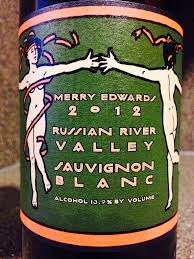
Recently—even thought I had looked at it many times before—I was taken by the unique label design on her Sauvignon Blanc. It is a creative and mirthful interpretation of the nude Three Graces from Greek and Roman mythology, whose primary responsibilities included overseeing parties and similar joyous social events. I might be reading too much into it, but I believe the Graces are engaged in what can only be interpreted as a Bacchanalian dance.  Given the above wild ride through history, is that cool, or what?

Tuesday, February 22, 2011

A Wine Book Like No Other

It’s been claimed that to maintain troop morale, Napoleon had ample supplies of Champagne accompanying his military campaigns. In WW I French, soldiers were provided the bubbly stuff in their trenches, and when WW II broke out, tools and guidelines were provided so soldiers could make their own mulled wine. But beyond that, not much, if anything, has been written about the effect, if any, on France’s wine industry during any one of those conflicts.

A short time ago, I revisited one of my favorite wine books that deals with that topic. It’s an engrossing, little-known tome, now in paperback, titled Wine and War: The French, the Nazis & the Battle for France’s Greatest Treasure. Authored by Don and Petie Kladstrub, it is based on several years of research and interviews, and covers the determined resistance and the harrowing, occupation experiences of five historic, well-known winegrowing families from the premier appellations of Burgundy, Bordeaux, Alsace, Loire and Champagne.

When WW II began, a significant portion of the French population was involved in the production and distribution of wine. (Some estimate a minimum of twenty percent.) Their national identity, indeed their very “French-ness,” was inextricably intertwined with wine—its storied history, its cultural and economic links, as well as its perceived, good-life sophistication. It was the nature and depth of those aspects that underpinned their resistance to Germany’s occupation.

The Nazi assault on France’s wine industry, the heart of its economy, began with the physical damage to the vineyards, followed by looting as the Germans advanced through the villages. It continued with Germany’s seizure of the key chemicals that the farmers needed to protect the vines. But the most ambitious aspect of the occupation was a wide-ranging economic plan, using wine industry-knowledgeable civilians—known as Weinfuhrers—to oversee and control the pricing, production, as well as the distribution of the wines from the above regions.

On the other hand, one of the most important and unanticipated occurrences during the occupation was the how the Weinfuhrers were more circumspect than their Nazi commanders about potentially damaging France’s economy and the wine trade in particular. While their actions were not always benign, they nevertheless managed a complex and difficult situation. As such, their conduct significantly eased Frances’ re-entry into the world wine market after the war.

The authors detail imaginative and occasionally amusing actions that winegrowers and storied restaurants took to limit the damage and losses to their vineyards and inventories. They also recount in memorable detail, a cinema-worthy, “wine tasting festival” that took place in one of the prisoner of war camps. (Who else but the French would or could conceive that?)

Intimate, real life experiences are what make for interesting historical reads. Wine and War has more than its fair share of them. If you crave wine information beyond the traditional topics of grapes and appellations, high critic ratings and the latest cult wines, this short, interesting read will likely satisfy.

Saturday, February 12, 2011

Today's Guest Blogger: Tom Engler

This guest post is a singular opportunity to also identify another, less well known but equally well endowed individual who has traversed that same long, winding road through the vineyards and wine shops. Another equally important topic is source material for all of us; a suggestion is forthcoming. The overall intent today is to keep to the subject that interests each of us while attempting to put a personal spin on my own journey and development of that “laser-like palate!”

Barring the odd bottle of Mateus or Riunite whilst in my youth, any wine experience was rare. It was the meeting up with a now dear friend in the western suburbs of Chicago during the late 1970’s that initialized the interest/involvement that resonates to this very day. Mr. R. D. Zajicek, culinary wizard, bon vivant and wine connoisseur is the fellow to whom I owe a deeply felt, sincerely considered, personal thank you. Rick not only has an extraordinary palate but has acquired an even more extraordinary cellar, not by hit or miss methods but by targeting only the very best product from California and France.

Sometimes the wines were relatively inexpensive but more often the opposite was true. The fact remains, excellence was his only criterion. He has illustrated that while the collecting aspect is challenging and great fun, the consumption is even more so; especially when sharing with family and friends, with fine food always being the perfect foil for that carefully selected bottle. He’s been proven to be absolutely right in that process because it’s the sharing that begets the true pleasure, with the added benefit of lively, intense conversations. Thank you for the concerted effort, the keen insight and mostly for the friendship.

So, after this tutelage and guidance from a master, how does one carry the message forward, to be a help and not a hindrance? A recommendation: a subscription to Connoisseurs’ Guide for California Wine. Please note, I have no personal interest in this publication. The charge is $90.00 for its print version, slightly more for the online access, and they do not accept advertising. The reviews are on domestic wines exclusively, mostly CA, OR and WA. The commentary is straight forward, clearly stated. What it has done is allow my personal search, and yours to if you subscribe, to be directed at "good" wines only rather than attractive labels. I have never had a recommended CGCW wine that was not superb in the last 25 years.

Some people think that I possess this "laser like" palate (thank you TB) but in fact my palate is no different, better/worse than anyone else. I just limit my purchases to those wines that have already passed an extremely stern exam. Another personal recommendation, CGCW notwithstanding, is that each wine enthusiast seek out that one single legitimate source who will continually provide impeccable information thus avoiding befuddlement with the unnecessary cacophony of too many voices. As Steven Stills said many years ago, ”For what it’s worth…”

Thursday, January 27, 2011

Into The Mists Of Wine's Origins

The other night, while swirling and sniffing my “winter red” and gazing into the flickering flames in my fireplace, I began to fantasize about wine’s origins; by whom and how it might have been first encountered. No doubt, some leathery, sun-baked Paleolithic person had some part in its discovery. I have this mind’s eye image of a brutish, hairy dude looking into a hollowed out, gnarled gourd that holds the remnant seeds, skins and fermented juice of some primitive vitis vinifera berries.

He proudly grunts to his animal-skin-clad mate, “Say Gladys, ya gotta check out this juice. I think it’s got possibilities.”

And as any matriarchal, cave dweller worth her fleur de sel would do, she most likely gave it a few quick, investigative sniffs, flicked her tongue into it to confirm safe and acceptable flavors, and then after taking a tentative sip, closed her eyes in pensive rumination.

“I don’t mean to be negative, Clyde, but I think it’s rather one dimensional. It has a pale color, simple aroma and a high acid profile. It’s rather Noveau. But having said that, I think with it’s engaging minerality, it might work quite well with tonight’s tuber tartar and braised field greens, especially when it cools down to cave temperature.”

“You know, Precious, I think you’re on to something. It might also pair well with that Beetle Paste you made the other day.”

“Pâté, My Big Strong Lover Man, It’s called Pâté.”

“Whatever.”

Not withstanding the above, I imagine that wine’s first dress rehearsal was not particularly exciting. It was most likely “lean, mean, and green,” and that’s probably being charitable. And how mankind was later able to craft it into such a beautifully balanced beverage of palate pleasing aromas and flavors is a feat worth celebrating.

But just as Man’s first non-water hole beverage of consuming interest—malt liquor—later to be known as beer, was initially domesticated for one particular reason, so to was wine’s primitive antecedents. Of course, you know of what I speak: The Buzz, the altered state of mind and euphoric bliss that created romantic nights near the Mesopotamian marshes and dreamy snoozes on their prehistoric Duxiana beds of pelts, leaves and twigs.

Paleolithic man may have downed it with the day’s hunting and foraging bounty, but he more than likely looked forward to his periodic, relaxing quaff for quite another reason.

“Is it cocktail hour yet, Precious?”

You, however, as a modern and enlightened Homo Sapien, have embraced wine for a different reason. You’re aware that a small glass of wine, every now and then, (health issues aside), is even more desirable than none at all. You know that in moderation and always with food, wine has health giving qualities that even your family physician, if you nudge him or her, will likely acknowledge. So, in this New Year with blessings all around us, pull the cork with friends and family and enjoy one of Mother Nature’s finest gifts.

Tuesday, December 28, 2010

Milk shakes and red wine as tender loving care


As a youngster, my siblings and I lived in a small town in the coal mining region of southeastern Utah. Our nightly entertainment was radio programs like The Shadow, The Lone Ranger and The Cisco Kid. We also read books, solved 500 piece jigsaw puzzles, and played Gin Rummy. On Saturday afternoon, we wolfed down freshly, buttered popcorn while transfixed by movie westerns with Roy Rogers, Gene Autry and, for the real old time trivia buff, Gabby Hayes and Wallace Beery.

Outside, in good weather, we explored the surrounding semi-desert countryside, or played “Cowboys and Indians,” “Marbles,” or "Mumbly Peg." At nightfall, nothing created more shrieking and mock trauma than “Hide and Seek.” When it snowed, we built bulbous snowmen, pummeled each other with  snowballs, and took eye popping belly sleigh rides down the nearby, not so gentle slopes. It was pure Norman Rockwell stuff.

And, of course, all those stressing activities brought with them the inevitable sore throat, high temperatures, or some other bed-confining ailment that required aspirins, mentholated chest rubs, and a little TLC. Tender Loving Care came in different forms—a steaming bowl of homemade chicken broth, a long tender embrace on Mama’s lap or another therapy that lingers most vividly in my emotional hard drives.

My father would close his tiny shoe shine parlor, cross the street to the corner “soda fountain,” order a thick, chocolate malted milk shake, and then, brown paper bag in hand, trek the mile or so home to present his personal version of Tender Loving Care. Just the sight of the waxy Dixie Cup container coming out of the paper bag lifted my mood immediately, and after just a few draws on the straw, my temperature seemed to drop in synch with the level of the milk shake. Recovery was well under way long before the bottom of the Dixie Cup was visible.

I recently spoke on the phone with my brother Stan, who, with his wife Lee, provided our aged mother a first class, heroic version of 24-hour care-giving for the last six years of her life. What brought the above Utah recollections to mind was my conversation with Stan about their dinner nights with Mama. Each night they served her a little wine with dinner—not much, maybe an ounce or two, but just enough to make dinnertime a little special. And just as chocolate, rather than vanilla, was my therapy of preference, red wine—not white—seemed to deliver the requisite impact for her. Pretty good palate I’d say.

In any case, that dinner ritual was Tender Loving Care at its finest, and those few ounces effectively delivered much more than their basic purpose. They lifted her spirits, ensured that she would eat, reminded her of the sacramental aspects of wine, and overall, including aiding digestion, probably did more good than many medications.

It’s interesting how a few of life’s necessities like food and drink can occasionally create a mindset and reaction that exceeds the properties of the underlying ingredients. That milk shake was far more than liquefied ice cream—it had magical, restorative powers. So too with those few ounces of red wine for my Mother. Both became, in a very real sense, far more than mere beverages. Special moments like that can happen—not very often—but they can happen.  Here's hoping you have a few of them in the coming New Year.

Thursday, December 2, 2010

Wine Clubs And Other Wacky Stuff

Lately, whenever I browse magazines, newspapers or mailings from wine stores or Internet sites, it seems they always contain eye-catching, multi-color, advertising inserts for wine clubs. Wine clubs are similar to other consumer clubs (DVDs, CDs, Books) that sell and ship their product, typically at reduced rates, at monthly or other recurring intervals. The Wall Street Journal, New York Times, San Francisco Chronicle, Zagat and virtually every other food and wine magazine are promoting their special niche offerings. In many cases, and to help close the deal, there is also a one-time special price reduction or gift if you agree to become a member immediately. Even though they are month-to-month contracts, the sellers expect that it will develop into a much longer relationship. Considering the relentless advertising, I must assume they do.

Wine clubs are worth considering for several reasons. First, they are failsafe birthday and Christmas gifts, because your loved one is reminded of your thoughtfulness with each delivery. Secondly, inasmuch as wines are shipped with descriptive tasting notes, the recipient can learn at his/her own pace. Thirdly, because of those tasting notes, clubs offer a stress-free way for beginners to expand their knowledge in the privacy of their own surroundings. This avoids the uneasiness of tasting with a group of strangers, (who, it seems, always know more about wine.)

Many organizations and entities are using wine clubs as a mechanism to strengthen and maintain relationships with their members. And one that really caught my eye was the Feminist Wine Club from the California National Organization of Women. (Which recalls an old and nasty joke about “whine and cheese” clubs.) If you have a NOW member in your circle of close friends, who is also a Pistol-Packin’ Mama, she just might get teary eyed with a club membership gift—and I kid you not—from the NRA Wine Club! That’s right, The National Rifle Association, who, I should mention, also provides a “custom NRA engraved wine box” that she can lovingly rub before each trip to the firing range with her AK 47.

A friend of mine claims that Bronco Wine Company, producers of Charles Shaw wines, (a.k.a. Two Buck Chuck) was planning a nationwide Two Buck Chuck wine club, but the idea was scrapped once they determined that the mailing costs exceeded the value of the wines. He also advises that a Riedel is planning a Stemware Replacement Club for those klutzy oenophiles, like this writer, who have discovered that hand drying Riedel glasses is an adventure far surpassing sniffing and sipping from them.

Lastly, uninformed sources tell me cable TV personalities Bill O’Reilly and Keith Olbermann are in the planning stages for their own wine clubs. The buzz is that Bill’s Bordeaux-styled wine, “Bloviating,” will be a fair and balanced blend of Right Bank varietals, while Keith’s screw-cap version, “Blowhard,” will be a 100% Cabernet Sauvignon from socially responsible and bio-dynamically farmed Left Bank vineyards. If those rumors prove true, I would expect that Jon Stewart to be close behind with an F-bomb-laden, newsletter detailing the socio-political implications of demeaning the vinicultural primacy of Zinfandel as “America’s Red Wine.”

Tuesday, October 26, 2010

Napa Valley Nuptials

Last weekend we drove to Napa Valley for the wedding of Amy Irvine and the man of her dreams, Mark Whiley. It was hosted by her parents and our good friends, Carolyn and Mike Irvine. The event took place at the historic, stone-walled Greystone, the St. Helena campus of the famed Culinary Institute of America (CIA). In addition to its degreed culinary programs, Greystone has a Wine Spectator restaurant, a Spice Islands marketplace, and a Vintners Hall of Fame.

We were greeted at the entrance by students with trays of sparkling wine and hors d'oeuvres of salmon tartar, lamb rib chops, and stuffed zucchini blossoms. After several rounds of refills and finger-lickings, we were led upstairs to the Vintners Hall of Fame where the gastronomic event unfolded.

Formerly the Christian Brothers Barrel Room, the Hall of Fame “celebrates the men and women whose collective vision, determination, and hard work have been responsible for the growth and worldwide prestige of the California wine industry.” The Hall’s walls are dotted with 2,200-gallon redwood wine barrels. On each barrel is a sculpted and spotlighted bronze plaque for each of the current 28 inductees. The room has great ambience and ideal for a large group celebration.

Our white-linen-draped table of ten was topped with an eye-catching, 21st Century arrangement of branch-like stems reaching upward to a cluster of beautiful Fall flowers. Miniature votives hung from the branches. Nearby there were four food stations, and each was staffed with cheerful CIA students uniformed in white tunics on which their names were red-stitched. The stations were topped with these gourmet temptations: Salad of Poached Maine Lobster; Bacon Wrapped Scallops; Risotto; Deconstructed Beef Wellington; Multi-National Cheese Station.

For this food and wine enthusiast, food stations offer the ideal arrangement for time and food management. I like to graze, and I like to graze at my leisure. The luxurious and delicate Maine Lobster salad savored with a glass of 2008 Raymond Chardonnay was the perfect opener for the progression to follow.

I’ve always enjoyed seared scallops and, for my second course, their bacon-wrapped version, which I requested over risotto, was as good as any. Another pour of the Chardonnay cleansed my palate, and I strolled around the Hall while pondering the timing of the Beef.

When I returned, the 2007 Mt. Veeder Cabernet was poured and waiting for me. The beef was rich and flavorful, perfectly medium-rare, a unique and enjoyable version of Wellington. The Cabernet, needless to say, was the ideal partner. I asked for another pour and edged to the Cheese station to assess its offerings.

The Cheese station was exceptional. I enjoyed all cheeses as well as the accompaniments of honeycomb, nuts and membrillo, a fruit-based jelly. The Cabernet was a perfect match. By now, I was sated and tried to decide if I could stay upright and dance to the rhythmic, rockin’ band that had many of the younger women dancing together in an exciting sisterhood, communal exhibition. Helga and I gave it a shot, but it was with the slower numbers where we found our comfort zone. Youth has its advantages.

I’m told we missed an end-of-evening, blazing sparkler send off for Amy and Mark, but we were able to wish them well at the “Morning after Brunch.” Carolyn and Mike outdid themselves, and I’m certain American Express really appreciates their efforts.

Monday, October 18, 2010

Through A Glass Starkly

 Wine enthusiasts know that quite a few years ago Riedel, (reedle) an Austrian wine glass producer, created an entirely new market niche of upscale, special purpose wine stemware. It’s underlying proposal, and one that has quite a few famous wine critics in agreement, is that the shape of the glass optimizes one’s level of wine appreciation. According to their information, the bouquet, taste, balance and finish are all affected by the shape of wine glasses that are individually designed for each wine and their underlying grape varietal(s). Since then, realizing that there were various levels of price-sensitive customers, their product line of hand blown and machine produced wine glasses has grown to over ten lines. At this writing they are the undisputed leaders in that market segment, particularly after buying out their major competitor.

However, I was surfing the Internet wine news recently and came across yet another entrant into the ultra-premium wine glass market. Silhouette is the name of their special wine glass, and while they concur with Riedel’s proposition that the wine glass makes all the difference, they moved into an entirely new direction by making a radical modification of traditional wine glass designs. Their stemware has a U-shaped gap in its side which allows you to place your nose well into the glass and closer to the wine. (I have a few friends who need no such assist and a few that definitely do. They all, however, are very handsome people.)

After taking several sniffs then, according to their video, you must remember to rotate the glass (i.e. the gap) 180 degrees to enjoy your first sip. Otherwise, if you’re distracted and don’t rotate, that opening will verily deliver the unintended but not surprising consequences of its provocative design. By the way, to help you overcome buyer’s uncertainty, their website proclaims ownership of the Silhouette “elevates you into that respected group of sophisticated wine drinkers.”  (If getting respect doesn't motivate you to place the order, nothing will.)

Truth be known, I agree that some crystal wine glasses are better suited than others when entertaining, particularly when it comes to pouring something special. And it is rather satisfying when swirling and sniffing a fine red wine from clear, thin-rimmed, tulip-shaped stemware.

If you’re in the market for wine stemware, they need not be expensive or hand made, and they shouldn’t require delicate hand-washing and drying. Except for Champagne flutes, which do perform their intended function quite well, all you really need is one large sized glass for swirling your reds and a smaller, more slender one for your whites. Otherwise, if you’re economizing, or need a few simple, utilitarian “daily drinkers,” a medium-to-large sized tulip-shaped glass will suffice for both red and white wines.